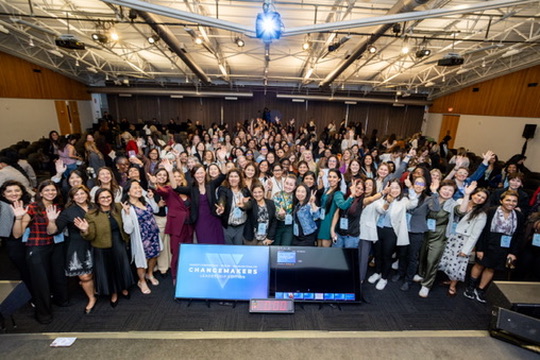
On October 13, I attended Women In Product’s Changemakers conference at the Computer History Museum. It was my third product conference this year, after ProductCon New York and MTPCon London.
The first two focused on what AI changes about the product role. WIP went further on what it takes to lead people once AI is part of everyday work. When speakers talked about AI, they mostly described what had already happened: Poshmark’s and CoderPad’s AI builds, Atlassian replacing a status meeting and training its own people, and Google’s Shimrit Ben Yair on why AI hasn’t freed up her time.
Here were my takeaways:
1. Speakers reported what happened when they built fast
Heather Gordon Friedland (Chief Product Officer, Poshmark) walked through two AI tiger teams. The first shipped, but QA, security, infrastructure, and cleanup slowed it down, and cleanup took nearly as much effort as the initial build. The second team, two people with one month, generated about 50 ideas and 10 live prototypes. The prototype they chose still needed specialists to harden it before it could ship. Her slide on how teams learned the AI tools put it simply:
“The tools were the easy part.”
Shared learning and changing how teams operated mattered more.
Amanda Richardson (CEO, CoderPad) had a different problem. CoderPad built an AI interviewer quickly during a wave of market excitement, and few customers used it, because recruiters’ real problem was sorting through an overwhelming volume of applicants. Her lesson was that being able to build something quickly isn’t a reason to build it.
Tamar Yehoshua (Chief Product and AI Officer, Atlassian) said speeding up one step tenfold doesn’t make delivery ten times faster if reviews, dependencies, incidents, and approvals stay the same. Her own example was replacing a recurring red/yellow/green status meeting with agent-generated OKR reporting. People’s resistance to losing the meeting was part of the challenge.
Connection to ProductCon: Mathias Davidsen (Miro) warned about the Velocity Trap, where fast AI-assisted delivery piles up code without maintainers and features with low adoption. CoderPad’s AI interviewer is the low-adoption side of that warning.
And to MTPCon: Hugo Raymond (Figma) and Ryan Davis (MONY Group) warned that AI makes prototypes look done before they are. Heather’s chosen prototype still needed specialists before it could ship.
2. You can change your mind without losing credibility if you agree up front on what would change it
Brandye Sweetnam (Senior Director of Product, Pinterest) ran a workshop on changing your mind as a leader. She argued that people trust leaders who are clear about intent, show their reasoning, apply the same principles consistently, and stay humble. A decision can be reasonable with the information you had and still need to change when new evidence comes in.
Her tool is an assumption stack:
- Write down the goal and the success metric.
- Pick the three to five assumptions the plan depends on most: the ones that are uncertain, expensive if wrong, slow to test, or hard to reverse.
- Name the evidence that would prove each one wrong.
- Set tripwires: a threshold, an owner, and a review date for each assumption.
When a team agrees on its tripwires before starting, a later change of course follows a rule everyone already accepted, so it doesn’t turn into a political fight.
When it’s time to explain the change, this is the structure I took away:
- Remind people of the original goal.
- Explain why the first decision was reasonable at the time.
- Say what changed.
- State the new decision and the principles that haven’t changed.
- Name the owner and the next review date.
Connection to MTPCon: Brian Cox closed that conference with a question: are you trying to be right, or trying to understand? Brandye’s tripwires settle in advance what evidence would change your mind.3. Nobody has AI figured out, including the people leading it
Shimrit Ben Yair (VP & GM, Google Photos, Google One and AI Subscriptions, Google) said AI has made email triage, prototyping, analysis, and dashboards easier, but her time hasn’t been freed. Expectations and output have sped up together. Senior leaders, she said, carry a public obligation to sound optimistic and a private fear of falling behind. Her response was to set boundaries, write meaningful congratulations herself instead of handing them to AI, and spend more time with users.
“We are the humans. We are in charge.”
Faye Iosotaluno (President & COO, Entangled Publishing) said that in the AI transition, nearly everyone is an outsider again. Having changed industries several times, she had advice for outsiders: assume your predecessors were thoughtful, ask how decisions came about before changing them, and run pre-mortems.
Tamar Yehoshua said it directly: nobody has everything figured out. Rather than treating AI skills as a hiring problem, Atlassian trained the people it already had through AI Builders Week, internal teachers, and leaders coding alongside their teams.
Connection to ProductCon: In my original recap, I wrote: “That’s not to say we have it figured out. None of us do.” At WIP, Tamar said the same about leading Atlassian through it.4. Your defaults decide who your product works for
“Your strategy says who your product is for, but your defaults decide who your product actually works for.”
Carolyn O’Hara (Senior Director of Product, Firefox) used the example of closet shelves built too high: a design that works for the person who built it and fails anyone shorter. Metrics can hide this because they only count the people who were able to use the product. When YouTube shipped a lighter page, measured average load time went up. Users on slow connections, who couldn’t load the old page at all, were finally showing up in the data.
AI can make it cheaper to serve people who were left out, but, in her words, “AI doesn’t fix the invisible part.” An evaluation set built from current users carries the same gaps. Before trusting a metric, ask: Who never made it into the data? Who can’t use the defaults? Whose behavior are we interpreting without context?
Connection to MTPCon: Hugo Raymond and Ryan Davis argued that as AI expands what any generalist can do, deep expertise like accessibility becomes rarer, not less valuable. Carolyn shared how Firefox used AI to add alt text to PDFs, which is that expertise built into an AI feature.5. For every ask, decide what people should know, feel, and do
Carol Isozaki (Founder & CEO, Strategic Brand Intelligence) told the story behind her framework, “Unfold the Flag.” While planning a memorial for her father, a U.S. Army veteran, she was asked whether she wanted a flag and almost said no, because the question left out everything it stood for: the honor guard unfolding and refolding the flag, Taps, and the presentation.
Product work gets presented the same way, “folded,” so she asks three questions for every audience:
- KNOW: What context does this audience need? Don’t assume anything “goes without saying.”
- FEEL: How should they come away feeling: heard, reassured, capable, proud, excited?
- DO: What exact action do you want from them? “That’s nice to know” is not a commitment.
“ALWAYS fold in emotions. Emotions MOVE PEOPLE TO ACTION.”
Stacy Brown-Philpot (Founder & Managing Partner, Cherryrock Capital) described what happens when a change ships folded. TaskRabbit’s move from bidding to direct hire worked in London but faltered in the United States because the company hadn’t prepared and communicated with its tasker community. With executives, she suggested opening with “As a reminder…” instead of “As you know.” Faye added that a change message needs to be repeated five to ten times because one good town hall doesn’t mean people understood it.
Frederique Dame (General Partner, GV) and Deb Liu (Board Member, Women In Product) applied the DO question to careers: “Tell people what you want.” Deb’s example was that someone could help her join a board only after she said explicitly that she wanted to.
Connection to MTPCon: Simonetta Batteiger’s business case template covers what leadership needs to know in financial terms. Carol’s framework adds what they should feel and do.