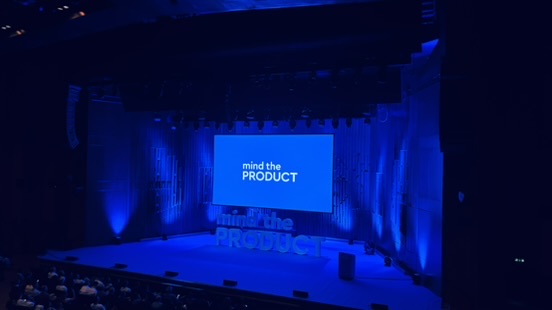
I traveled to London for Mind the Product’s annual conference and stayed long enough to explore the city, not just pass through it.
The energy was different from ProductCon New York a few weeks earlier. There was less urgency about the AI wave and more interest in what actually holds up once it’s arrived: what’s irreplaceable, what the real job of a product person looks like now, and whether we’re measuring the right things.
If one question ran underneath both days, it was this: now that building is getting easier, what does a product person actually contribute?
Here were my takeaways.
1. When you ship twice as fast, quality doesn’t scale automatically
John Moriarty (Design Director, Fin) opened with Intercom’s numbers: three times the engineering activity, 94% of code authored by AI, and twice the product changes shipped in a year.
When output increases, quality doesn’t automatically keep up. Intercom’s answer was a taste map: experience standards shared across R&D, making quality something everyone had a shared responsibility for.
Hugo Raymond (Figma) and Ryan Davis (MONY Group) flagged another consequence of the same shift. As AI makes early outputs look polished, the signal that something is still rough disappears. Prototypes and draft specifications look done before they are.
When there’s no indication that something is unfinished, people respond to it as though it isn’t. Teams need shared conventions for what stage something is at, so decisions aren’t made on the wrong artifact.
That felt relevant to my own work using clickable prototypes to get earlier feedback. Making a prototype feel familiar helps people respond to it, but its polish shouldn’t imply that every decision has been settled.
2. Specialization is a competitive advantage again
“The medium is being pushed forward by people who can interrogate what’s being created, not just generate it.”
Hugo and Ryan’s argument challenged the idea that AI erodes specialist value by raising what generalists can do.
Their view was that as AI expands what any generalist can produce, deep expertise—accessibility, regulatory knowledge, user research craft—becomes more valuable. AI can draft, but someone still has to own and interrogate the output.
Being able to generate something and being able to evaluate it are different skills. The second still depends on knowing the subject well enough to recognize what’s missing.
3. Product teams need to learn to speak in money
Former controller turned product leader Simonetta Batteiger (Inclusive Leaders) named a problem I hadn’t heard articulated this cleanly: product teams show up on the profit-and-loss statement as an R&D expense, while their contribution to revenue can be harder to see.
If we never translate our work into financial language, leadership can struggle to understand what disappears when the team gets cut.
Her framework maps each initiative to one of four outcomes:
- Increase revenue
- Protect revenue
- Save cost
- Avoid cost
The financial effect needs an explanation, including the assumptions behind it. Her suggested structure was:
By doing [X], we move [Y driver] by [Z range], resulting in [$A–$B] in [revenue, savings, or cost avoidance] by [timeframe].
I came away with a business-case template and a different way to approach my roadmap.
4. Product is hard. It should still be fun.
Charity Ibhadon (Global Product Director, WPP) didn’t open with a framework. She opened with a truth: product management will not get easier.
The ambiguity, the accountability without authority, and the pressure from every direction aren’t necessarily a phase you grow out of. You get better at operating within them.
“Product will not get easier. But you can enjoy it more.”
She also had a sharper point about the content PMs consume. There is more product content than ever, and much of it is engineered to make you feel behind.
“80% of PMs are doing this wrong.” “AI will replace PMs.”
Fear drives engagement. The question I took away was: is this making me better, or just making me anxious?
5. Someone still has to own the outcome
Faith Forster (Founder, Discoveree) co-created the Makers Manifesto, a shared set of principles for the AI era of building.
As building gets faster and more automated, the temptation grows to let AI absorb consequential calls. The manifesto’s counter was that someone still has to own the outcome.
“You can delegate decisions; you cannot delegate accountability.”
That’s especially relevant in healthcare and financial services, where responsibility for a decision has consequences for real people.
What I’m carrying forward
Across the sessions, I kept returning to the same responsibilities: know what’s worth building, scrutinize what AI produces, translate the work into financial terms, and own the outcome.
Those responsibilities become more important when we can ship faster. Without good judgment, we risk delivering more things that don’t add value.
Professor Brian Cox closed with a question that tied it together: are you trying to be right, or trying to understand?
It’s worth asking often.