My improv journey started at Mile Square Theatre, learning from Tarik R. Davis. Since then, I’ve explored improv, sketch comedy, musical improv, and storytelling. Somewhere along the way, I started noticing changes in how I showed up at work.
I became more aware of when I was planning my response instead of listening. I got more comfortable making a choice without knowing where it would lead. I also learned to let go of how I expected things to turn out.
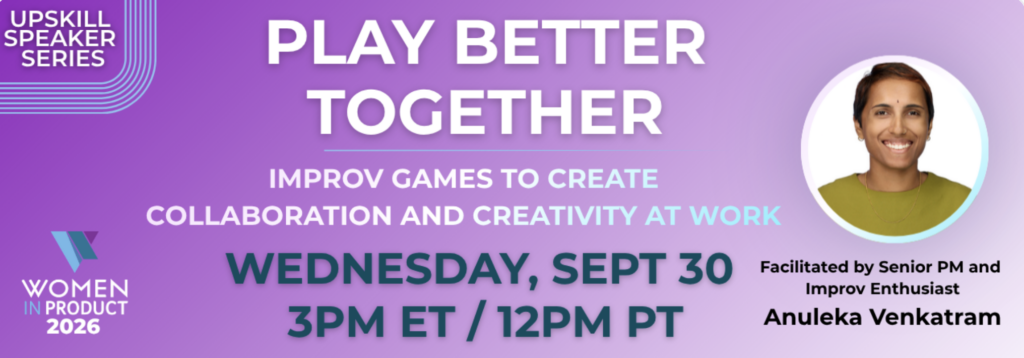
I wanted to give other product managers a chance to practice some of these habits, so on September 30, I led Play Better Together: Improv Games for Product Managers, a workshop built around three improv games I had learned.
One Word at a Time: Listening Before Solving
In One Word at a Time, a group tells a story together, with each person contributing exactly one word. You might be planning the end of a sentence when someone adds a word that changes its meaning. Suddenly, what you were preparing to say no longer fits.
Imagine a customer telling you that a particular task takes too long. You might immediately start thinking about how to reduce the number of steps. But if you ask them to walk you through the task, you may discover that most of the time is spent waiting for someone else to approve it.
That changes which part of the process you need to investigate. You wouldn’t have learned that if you’d started proposing solutions before hearing the full explanation.
Yes, And: Building on Others’ Ideas
In Yes, And, one person establishes something, and the next person accepts it and adds to it. That can be harder than it sounds, especially when someone introduces an idea you wouldn’t have chosen.
In product development, ideas often change as different people contribute their perspectives. A PM might suggest one approach, an engineer might identify a technical consideration, and a designer might see another way to address the customer’s problem.
Yes, And reminds me to stay open to those contributions. An idea doesn’t have to develop exactly as you imagined for it to become a good solution.
Fortunately / Unfortunately: Adapting When Plans Change
In Fortunately / Unfortunately, people build a story by alternating between fortunate and unfortunate developments. Every contribution changes the circumstances, and the next person has to continue from there.
Imagine a team preparing to build a feature based on a recurring customer request. New research reveals that customers are asking for the feature because they’re struggling with a different part of the product. The team now has to reconsider their approach in light of what they’ve learned.
Fortunately / Unfortunately teaches us to adapt when a story takes an unexpected turn. In product development, that means being willing to revisit a plan when new information challenges the assumptions behind it.
Give It a Try!
I’m still learning how to apply what improv has taught me, both onstage and at work. That’s part of why I keep coming back to it.
If you’d like to try these games with your team, the workshop handout has instructions and prompts for all three exercises. The stories might get ridiculous (a haunted laptop, anyone?), but that’s part of the fun.